
JOEL LOONEY COUNSELING · CLARITY
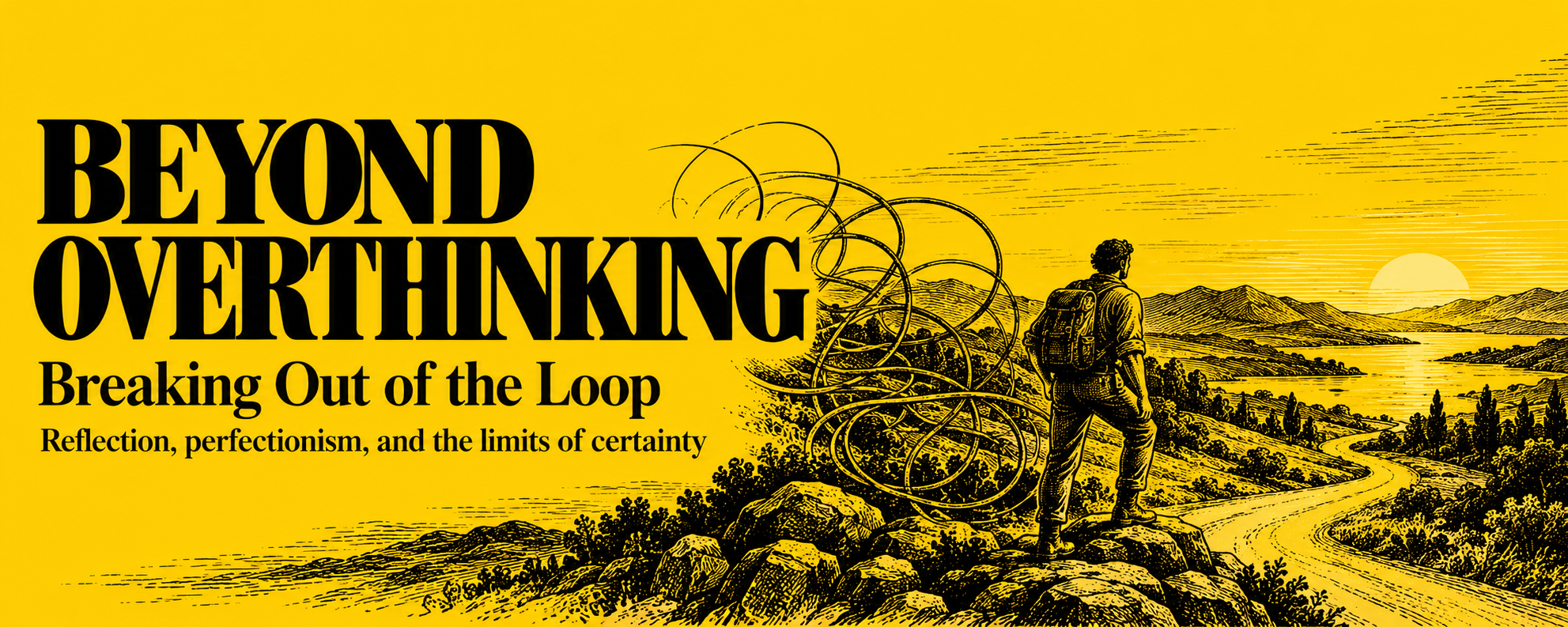
Beyond Overthinking:
Breaking Out of the Loop
Reflection, perfectionism, and the limits of certainty
“It is he who sits above the circle of the earth.”
— Isaiah 40:22, ESV
The prophet Isaiah pictures God enthroned above the earth, stretching out the heavens like a curtain. The nations are small before him, their rulers temporary, their strength no match for the One who calls the stars by name.
We do not see the world from that height.
We live within it. We can remember the past and anticipate the future, but we cannot occupy tomorrow. You can observe another person's behavior without knowing his thoughts. You may spend years examining yourself without becoming entirely transparent to your own motives.
Our understanding is remarkable, but it is limited. And we do not bear those limits patiently.
Perhaps you've reached a decision after careful consideration, only to find yourself reconsidering it the following morning. Another possibility occurs to you. Another doubt arises. You review the evidence, imagine a different outcome, and return to the beginning.
Or perhaps a conversation continues long after it has ended. You replay the exchange, consider what the other person meant, and rehearse replies that will never be spoken.
Sometimes this is responsible reflection. But sometimes we find ourselves going around in circles.
In Orthodoxy, G. K. Chesterton describes the confinement of a mind that can reason indefinitely without escaping its own assumptions. A circle, he observes, can be traversed endlessly without expanding. Its very perfection is part of its confinement.
We can spend hours analyzing a problem without discovering anything new. We can construct elaborate explanations that merely confirm what we already believe. We can search for certainty long after we've gathered the information reasonably available to us.
And the very ability that ordinarily helps us find our way becomes part of what keeps us trapped.
The challenge is to recognize when this has happened, why we remain inside the circle, and what might open a way beyond it.
1. The Power of Reflection
Thinking is one of our greatest human capacities.
We can examine experience, compare possibilities, question assumptions, imagine consequences, and learn from mistakes. We can recognize that our first interpretation was mistaken or that an appealing course of action carries difficulties we hadn't considered.
A physician investigates symptoms. A craftsman studies his materials. A father considers the effect of his words upon his child. A husband reflects on his part in an argument.
Reflection makes wiser judgment possible.
Within the four masculine archetypes, these capacities belong especially to the Magician: the observer, interpreter, and bearer of knowledge.
The mature Magician sees distinctions that others overlook. He understands how things work and applies his understanding with skill. He can stand back from immediate experience long enough to discern something about it.
Yet intelligence and discernment are not identical. You may possess a formidable analytical mind and still fail to recognize when analysis has ceased to help you.
When thought becomes repetition
Psychologists distinguish several forms of repetitive thinking.
Reflection examines experience in pursuit of understanding. It may reveal a pattern, correct an assumption, or clarify a problem.
Worry anticipates possible future threats. It often involves imagining what might go wrong and how those outcomes could be prevented.
Rumination repeatedly returns to distress, its causes, consequences, or implications. It may involve replaying an event, reconsidering a failure, or questioning what an experience means about oneself.
These activities overlap. What matters is not repetition alone, but the way we think and what the thinking accomplishes.
Psychologist Edward Watkins's research on repetitive thought shows that its consequences depend partly on context, emotional content, and whether thought remains abstract and evaluative or becomes concrete and specific.
Consider two questions about a difficult conversation:
What happened, what did I contribute, and what might I do differently?
Why do I always make such a fool of myself?
The first examines an event. The second invites a sweeping judgment about the self. It may lead into a familiar circuit of shame, with each apparent answer producing another accusation.
The distinction is not between pleasant and unpleasant thoughts. Honest reflection can be painful. Nor does depth of thought constitute overthinking. A scientist may spend years investigating a problem; a philosopher may devote his life to a question.
But there is a difference between returning to a question with something new to consider and returning to it because you cannot bear to leave it alone.
The centipede's dilemma
An old comic verse tells of a centipede who walked along happily until a toad asked which leg she moved first.
The question troubled her so badly that she could no longer coordinate her steps.
What she had done naturally became difficult once she attempted to supervise every movement.
The joke contains a recognizable truth. A musician may play confidently until he begins scrutinizing every movement of his fingers. You may find yourself speaking naturally with a friend, then suddenly become so concerned about making a good impression that you begin monitoring every word.
What had been effortless now demands your full attention.
The centipede illustrates excessive self-consciousness rather than rumination in the clinical sense. But both reveal how attention, when poorly directed, can interfere with the activity it is meant to serve.
The solution is not always more conscious control. Sometimes we need to take our eyes off ourselves.
2. The Closed Circle
If overthinking were merely an unpleasant habit, we might expect people to abandon it readily.
But thinking promises something.
Perhaps you continually anticipate problems because you believe worry keeps you prepared. Perhaps you replay an embarrassing conversation in the hope of finding an explanation that will finally put it to rest. Or perhaps you reconsider decisions because another round of analysis promises protection from regret.
The activity continues because it appears to serve a purpose.
The promise of reassurance
Psychologist Adrian Wells's work on metacognition examines the beliefs people hold about their own thinking.
Some believe that worrying prevents mistakes or keeps them vigilant. Others become frightened of their inability to control worry itself. Such beliefs can sustain prolonged mental activity even when it becomes exhausting.
A familiar pattern begins with doubt.
You investigate the concern, examine the evidence, and reach a reassuring conclusion. For a while, you feel better.
Then the doubt returns.
Perhaps you've overlooked something. Perhaps another possibility deserves attention. Perhaps the reassurance wasn't sufficient.
So you investigate again.
Each round promises the certainty the previous round failed to provide.
Over time, the relief itself can help maintain the cycle. We return to the question not because the evidence has changed, but because the discomfort has returned.
This pattern is particularly important in anxiety and obsessive-compulsive difficulties, though ordinary worry can sometimes follow a similar course.
The mind begins mistaking the return of discomfort for the discovery of a new problem.
The circle of our assumptions
Chesterton's image suggests another form of confinement.
Sometimes we aren't merely revisiting a question. We are reasoning from assumptions we have stopped examining.
Suppose you believe your colleagues secretly regard you as incompetent. Criticism confirms your suspicion. Silence suggests concealed disapproval. Even praise may seem like an attempt to spare your feelings.
Your explanation accommodates everything.
But an explanation that can absorb every possible observation is difficult to correct. It has become a closed system.
You may reason with great sophistication while arriving repeatedly at the same conclusion. More information doesn't necessarily help because every new fact is made to serve the original belief.
This is one danger of an intelligent mind: it may become exceptionally good at defending a mistaken premise.
A better question can sometimes accomplish more than another answer.
What would count as evidence that my interpretation is wrong?
If nothing would, the problem may lie less in the available evidence than in the boundaries of the explanation itself.
The limits of control
There is another circle we draw around ourselves: the boundary of what we believe we must control.
You may have spent years anticipating problems, examining risks, and preparing carefully. These habits may account for much of your success.
But the same approach can fail you in an uncertain relationship, an unpredictable future, or a decision whose consequences cannot be guaranteed.
Rather than acknowledge the limits of preparation, you prepare more.
Your analysis becomes increasingly elaborate, but the demand beneath it remains unchanged.
You want to be safe from what you cannot know.
For some men, this becomes the particular torment of perfectionism.
The relief can be real yet short-lived. The return of discomfort is not necessarily new evidence.
3. Perfectionism and the Fear of Being Wrong
Perfectionism is not simply the desire to do something well.
A conscientious man cares about the quality of his work. He takes his responsibilities seriously, notices mistakes, and makes corrections.
The perfectionist may share these virtues. But his standards can carry an additional burden.
A mistake may threaten his identity.
He doesn't merely fear an unfavorable result. He fears being exposed as inadequate, foolish, irresponsible, or unworthy of respect.
The task has become a referendum on the man.
When excellence becomes protection
Think of a presentation you need to give.
You organize the material, check your figures, anticipate questions, and practice your delivery.
All of this is useful.
But perhaps you continue rehearsing because you cannot bear the possibility of embarrassment.
You imagine technical failures, difficult questions, forgotten details, and unfavorable reactions. For every contingency you address, another appears.
Eventually, you're no longer preparing principally to communicate well. You're trying to protect yourself from being seen making a mistake.
Every revision promises another measure of security. Another rehearsal might eliminate the awkward pause. Another round of research might protect you from the question you cannot answer.
But excellence cannot guarantee invulnerability.
The critic within
The perfectionist may carry an audience of critics wherever he goes.
He anticipates their objections before speaking. He imagines their disappointment before attempting anything. He evaluates his performance before it has begun.
The criticisms may be intelligent. Some may even be deserved.
But his inner critic has turned the possibility of judgment into a courtroom where he must answer every charge before he can proceed.
No preparation is sufficient because no possible performance is immune to criticism.
Perhaps you recognize that courtroom in your own head.
You haven't made the decision, but you've already imagined explaining why it went wrong. You haven't begun the project, but you've pictured someone discovering its weaknesses. You haven't spoken honestly, but you've rehearsed the ways your words might be misunderstood.
You may appear indecisive, but the difficulty is more personal than a failure to choose.
You're afraid of what an imperfect decision might reveal about you.

When eighty percent feels like failure
Imagine that you've gathered the relevant information and reached a reasonable conclusion.
For illustration, suppose you feel eighty percent certain.
That number is not a rule for deciding. The appropriate degree of confidence depends upon the consequences of being wrong, the available evidence, and the possibility of correcting course.
But consider the remaining uncertainty.
For the perfectionist, the unresolved twenty percent may feel unbearable. It leaves room for a mistake, for criticism, for the humiliation of discovering that he was wrong.
You can imagine looking back upon the decision and wishing you'd considered one more possibility.
So you consider it now. And then another.
At some point, further analysis becomes a way of postponing the vulnerability that no amount of analysis can entirely remove.
To proceed without complete assurance feels like surrendering something essential to your security.
From the outside, the remaining risk may seem ordinary. From the inside, accepting it can feel like death.
Perfection or paralysis
Winston Churchill recognized the practical danger of perfectionism in the demands of wartime leadership.
In a 1942 memorandum concerning landing craft, he reduced the maxim that nothing short of perfection would suffice to a single consequence: paralysis.
The observation is sharp because serious work always involves competing demands. A further refinement might improve the result. It might also consume time, delay necessary work, or prevent something worthwhile from being attempted.
There are tasks in which extraordinary precision is indispensable. But there are others in which competent effort, sound judgment, and the willingness to correct mistakes are sufficient.
The perfectionist may impose the standards of the first upon the second.
Chesterton offered a different challenge in What's Wrong with the World:
“If a thing is worth doing, it is worth doing badly.”
He was defending the amateur: the person who does something because it is worth doing, not because he can outperform everyone else.
You needn't be an accomplished musician to sing with your child. You can enjoy painting without becoming a gifted painter. You may take pleasure in tending a garden that will never win a prize.
The value of these activities does not depend entirely upon the quality of our performance.
This is a difficult freedom for the perfectionist. He has learned to approach life as a series of performances in which competence must be established and weakness concealed.
Even recreation may become another opportunity for self-evaluation.
In trying so hard to avoid doing things badly, he may begin avoiding things that would have been good to do.
4. What Thinking Cannot Give Us
Some questions remain unanswered because we lack information. Others remain uncertain because their answers depend upon a future we haven't lived.
These are different problems.
If you don't understand a contract, examine its terms and obtain qualified advice. If you want to know whether signing it will prove to be the best decision ten years from now, further inquiry can only take you so far.
We can weigh evidence, estimate consequences, and exercise judgment. We cannot possess the future.
Knowledge and experience
Aristotle distinguished theoretical knowledge from practical wisdom and productive skill.
Understanding the principles of an activity is not the same as knowing how to perform it well in particular circumstances.
You can study leadership without knowing what it is like to bear responsibility for a team. You can understand the virtues of marriage without knowing everything that loving a particular person will require. You can recognize the value of courage without knowing how you'll respond when something dear to you is threatened.
Theoretical understanding may prepare us extensively. But some knowledge develops through participation.
Consider vocation.
You might examine several possible careers, assess your abilities, study the opportunities, and seek counsel from people you respect.
Yet you may not discover whether you enjoy teaching until you teach, or whether you possess an aptitude for leadership until you exercise it.
Reflection can clarify possibilities. It cannot give us the experience of living all of them.
Kierkegaard's work on possibility and commitment helps expose the difficulty. We can remain indefinitely among contemplated alternatives, preserving each one in imagination. But a real commitment brings us into a definite life, with definite limits.
Choosing one path means surrendering others. There is loss in that, even when the choice is good.
The desire to avoid every possible regret can leave us with a life spent preserving possibilities we never inhabit.
The other person beyond our interpretation
Relationships present another limit to analysis.
Suppose your wife seems unusually quiet.
You begin considering explanations. Perhaps she's disappointed in you. Perhaps something you said upset her. Perhaps she's preoccupied with a problem unrelated to your marriage.
You remember previous interactions, reconsider your words, and attempt to understand her behavior.
Eventually, you may have developed an elaborate explanation. But you haven't spoken with her.
Your interpretation may contain insight. It may also be mistaken.
We can know others through observation, memory, conversation, and inference. Yet another person is never exhausted by our explanation of him.
Martin Buber explored the distinction between treating another person as an object of understanding and encountering him in genuine relationship.
This matters especially when we're familiar with psychological language.
A husband may recognize his wife's tendency to withdraw when distressed. A wife may understand her husband's defensiveness in light of his upbringing.
These observations can foster compassion. They can also become fixed interpretations through which every new interaction is understood.
Instead of listening, we assume we already know.
A good explanation should help us listen more carefully. It should not replace listening.
Sometimes private reflection is necessary, particularly before a difficult conversation. But speculation cannot indefinitely substitute for the perspective of the person involved.
Understanding without feeling
We can maintain a similar distance from ourselves.
Perhaps you can explain your anger with considerable psychological sophistication. You understand your childhood experiences, recognize your defensive habits, and identify the beliefs that contributed to your reaction.
But when someone asks what you felt during the argument, you return to the explanation.
You know why you became angry without readily acknowledging that you were hurt.
Psychologists sometimes call this intellectualization: approaching emotionally significant experiences primarily through abstract thought.
It can provide useful distance when feelings are overwhelming. The difficulty arises when explanation becomes a habitual substitute for emotional awareness.
Within our archetypal framework, this illustrates the relationship between the Magician and the Lover.
The Magician brings understanding, discrimination, and insight. The Lover brings receptivity, emotional presence, and participation.
Without the Magician, we may struggle to understand our experience. Without the Lover, we may remain strangely absent from it.
You can know a great deal about yourself while remaining reluctant to be known.
5. The Foolishness of the Cross
The opening image from Isaiah reminds us that the world exceeds the limits of our sight. We cannot stand outside our lives to examine them from beginning to end.
The book of Job makes this limitation painfully personal.
The God who questions us
Job has suffered devastating losses. His friends offer explanations, but Job refuses to accept their easy accounting of his suffering. He wants to present his case before God.
When God finally speaks, he does not begin by explaining why Job has suffered.
He speaks from the whirlwind:
“Gird up now thy loins like a man”
— Job 38:3, KJV
Then comes the question:
“Where wast thou when I laid the foundations of the earth?”
— Job 38:4, KJV
God speaks of the sea's boundaries, the storehouses of snow, the stars, the mountain goats, and creatures whose lives unfold beyond human supervision.
Job is confronted with a creation whose depths he cannot fathom.
His suffering is not imaginary. His friends have not been vindicated by their explanations. And the divine response is no tidy solution to the problem of pain.
But Job has demanded to see the whole from a position within it. The questions reveal the distance between his understanding and God's.
If you've ever demanded an explanation for something painful, you may recognize the difficulty. You want not merely an answer, but an answer large enough to make the suffering intelligible.
Sometimes no such answer is available to us.
Yet Job is not left speaking into an empty heaven. God has answered him.
Job does not receive mastery over the mystery of his suffering. He encounters the One whose wisdom exceeds it.
Wanting to know enough to stop trusting
Genesis 3 presents another confrontation with the limits of creaturely knowledge.
The serpent promises knowledge associated with becoming like God. The woman sees that the forbidden tree is desirable for gaining wisdom.
The problem is not curiosity itself. Scripture elsewhere praises wisdom and understanding. The temptation is to seize what God has forbidden and establish independence from the One who gives life.
There is an echo of that temptation in the perfectionist's pursuit of certainty.
You want to foresee the consequences of your decisions before accepting responsibility for them.
You want assurance that obedience will not expose you to loss.
You want to guarantee that your efforts will succeed before committing yourself.
You do not merely want to know.
You want to know enough that you no longer have to trust.
The death of a false security
For a man who has spent years establishing his security through competence, this is no small matter.
He has learned to anticipate problems, conceal weaknesses, perform well, and avoid criticism.
Perhaps these habits have brought him considerable success. Perhaps they developed in circumstances where mistakes were met with humiliation, punishment, or danger.
His need for control may have a history that deserves to be understood.
Yet the strategy cannot deliver what it promises.
However carefully you think, you remain capable of error. However thoroughly you prepare, you cannot guarantee the outcome. However intelligently you explain yourself, you cannot escape the vulnerability of being known by others.
To accept these limits may feel like surrendering the very thing that has kept you safe.
There is a kind of death involved—not the death of intelligence or conscientiousness, but the relinquishment of a false security.
Here Paul's account of the cross becomes searching.
Writing to the Corinthians, Paul says:
“The foolishness of God is wiser than men, and the weakness of God is stronger than men.”
— 1 Corinthians 1:25, ESV
The instrument of shame and apparent defeat becomes the place where God reveals his saving power.
Paul is speaking of God's work in Christ. Yet the cross also overturns the standards by which we so often measure strength.
Human wisdom expects power to secure itself against humiliation. The cross confronts us with the God who willingly enters it.
The perfectionist wants his competence to save him from weakness, exposure, and failure. He has made mastery into a form of self-protection.
Christian discipleship calls that false self-sufficiency into question.
What must be crucified is not the desire for excellence.
It is the demand that excellence save you from being human.
The wound of truth
You may have constructed an elaborate defense against being wrong.
You anticipate objections, explain your motives, correct your mistakes, and conceal your weaknesses. Much of this may be genuinely useful.
But beneath your careful reasoning there may be assumptions you seldom permit yourself to question.
If I make a mistake, I will lose their respect.
If I cannot justify my decision completely, I have been irresponsible.
If I expose my weakness, I will no longer be safe.
These assumptions can become the unexamined premises of your reasoning. You may spend years refining your conclusions without questioning the fears upon which they rest.
Scripture gives us a searching image of truth:
“For the word of God is living and active, sharper than any two-edged sword”
— Hebrews 4:12, ESV
The passage speaks of God's word discerning the thoughts and intentions of the heart. Nothing remains hidden from his sight.
For someone who has spent his life avoiding exposure, that prospect is frightening.
What if your elaborate explanations are not as innocent as they appear? What if your devotion to preparation sometimes conceals a fear of being seen as inadequate? What if another round of analysis is defending your pride rather than serving wisdom?
Truth may wound our self-conception before it frees us.
But Hebrews does not leave us exposed before an unsympathetic judge.
The passage turns toward Christ, our great high priest, who knows human weakness and invites us to approach God for mercy and grace.
The man whose security rests upon perfection desperately needs this assurance: he can be fully known without first becoming flawless.
He need not keep every weakness concealed.
The cross does not require him to despise reason or competence. It confronts the false security he has tried to build from them.
What is surrendered is not his humanity, but the illusion that he can escape its limits through flawless performance.
The circle and the cross
Chesterton contrasts the closed circle with the cross.
The circle returns upon itself. Its movement can continue indefinitely without changing its boundaries. The cross extends outward.
In Orthodoxy, Chesterton uses these shapes to illuminate the difference between a self-enclosed rational system and a faith capable of making room for mystery.
He describes the cross as:
“a signpost for free travellers.”
For the perfectionist, the image offers a difficult invitation.
The way beyond your circle may not be another explanation. It may require surrendering the demand that everything be resolved before you can live faithfully.
You needn't abandon reason. You must abandon the hope that reason can make you invulnerable.
That surrender may feel like death because it exposes the weakness you've spent so long trying to conceal.
But what dies is not your capacity for wisdom. It is the illusion that you can make yourself safe from the conditions of your own humanity.
An illustration of Chesterton's philosophical imagery—not a claim that faith removes uncertainty or substitutes for clinical care.
6. Breaking Out of the Loop
Before you can leave a familiar mental circuit, it helps to recognize which one you're traveling.
Not every instance of overthinking has the same cause. The man who lacks important information has a different problem from the one who repeatedly seeks reassurance. A distorted interpretation differs from excessive self-monitoring. Perfectionistic checking may contain elements of several patterns.
The question is what your thinking is doing.

The Reflection Test
When you find yourself returning repeatedly to the same concern, ask: What is actually unknown? What happens each time you revisit it? What could genuinely improve your understanding?
The interactive Reflection Test below helps you distinguish missing information, temporary reassurance, closed interpretations, excessive self-monitoring, perfectionistic checking, and questions only time or experience can answer. Several patterns may overlap. It is a tool for reflection, not a diagnosis.
Which loop are you in?
Choose the pattern that most resembles how you are thinking about a concern. The suggestion below changes with your choice.
The courage to decide
There is a small piece of history hidden in the word decision.
It comes from a Latin verb meaning “to cut off.” The same ancient root for cutting appears in incision and scissors.
To decide is, in a sense, to make a cut.
Choosing one course means relinquishing others. Possibilities that remain attractive in imagination must be surrendered when we commit ourselves to a particular life.
Perhaps you keep returning to your alternatives because you hope to discover a choice that will spare you from losing anything worthwhile.
But no amount of analysis can make every possible life available to us.
The task is to make the cut wisely, not to pretend that it can always be avoided.
Ecclesiastes offers the image of a farmer studying the weather:
“He who observes the wind will not sow, and he who regards the clouds will not reap.”
— Ecclesiastes 11:4, ESV
The farmer is not wrong to consider the weather. A foolish farmer might sow into a storm and lose his seed.
But there comes a point at which watching the clouds becomes a substitute for farming.
The passage continues by acknowledging the mystery of God's work. We do not know everything that will happen or which of our efforts will prosper.
The farmer must work with the knowledge he has, accept the risks that belong to his labor, and entrust what exceeds his control to God.
So must we.
When sound judgment has done its work, the remaining possibility of failure is not necessarily a reason to begin deliberating again.
Sometimes the cut must be made.
When the critic returns
You may find that doubt persists after you've reached a sound judgment.
Another objection occurs to you. You picture someone criticizing your decision. You imagine the embarrassment of discovering that you were wrong.
Your internal critic insists that these possibilities prove you haven't prepared enough.
But another possible objection does not necessarily justify reopening the question.
You can listen to criticism without submitting yourself to endless prosecution.
Examine the objection. Consider its merit. If it reveals nothing new, you needn't begin the entire inquiry again.
There is no need to force yourself into certainty you don't possess. You are allowed to make a responsible judgment while knowing that you may still be mistaken.
Permission to be human
Some of the most valuable things in life require participation before mastery.
We learn an instrument while enduring the sound of our mistakes. We develop skill through work that initially falls short of our standards. We learn the demands of friendship, marriage, and parenthood through relationships in which we cannot always perform perfectly.
The perfectionist may have spent years trying to avoid these experiences.
But a life designed to prevent every embarrassment will also exclude a great deal of growth, intimacy, adventure, and pleasure.
Chesterton's amateur enters the picture again.
He participates because the thing itself is worth loving. He is willing to do it imperfectly because he has found something more valuable than the appearance of competence.
That is a freedom you may scarcely remember possessing.
7. Beyond the Circle
A circle can be traversed endlessly without growing larger.
So can an explanation.
You may return to the same questions for years, refining your arguments, anticipating objections, and searching for a certainty that never arrives.
Sometimes another examination is warranted. Sometimes you've already learned what the available evidence can teach you. And sometimes you continue because you cannot accept what remains uncertain.
For the perfectionist, relinquishing that demand can feel like the loss of everything upon which his confidence rests.
But the freedom he seeks cannot be obtained by becoming invulnerable.
Job stands before a God whose wisdom he cannot comprehend. The farmer in Ecclesiastes must sow without possessing tomorrow. And at the center of Christianity stands the crucified Christ, through whose apparent weakness God accomplishes his saving work.
None of these images invites us to despise understanding. They reveal its limits.
You may pursue excellence without making perfection the condition of your worth. You may examine your motives without becoming consumed by self-examination. You may come to know another person deeply without exhausting the mystery of who that person is.
Some knowledge comes through study. Some through conversation, experience, and years of patient attention. Other things remain beyond our reach.
The world does not depend upon our ability to understand it completely.
Nor do the things most worth loving require us to become flawless before we can receive them.
Chesterton's cross opens outward.
Beyond the familiar circuit of our own thoughts are people to love, work to undertake, beauty to enjoy, and a God who has never required our omniscience.
There is room for us there.
Personal reflection
Choose a recurring concern. The aim isn't a flawless explanation of your mind—that could become another circle—but a clearer sense of what deserves attention.
Your answers remain in this page on your device. They are not sent to Joel Looney Counseling by this code. Download to keep a copy; navigating away may lose them.
Research, sources, and further reading
Psychology
- Watkins, E. R. (2008). Constructive and unconstructive repetitive thought. Psychological Bulletin, 134(2), 163–206. DOI: 10.1037/0033-2909.134.2.163.
- Wells, A. (2009). Metacognitive Therapy for Anxiety and Depression. Guilford Press.
- Wells, A. (2010). Metacognitive theory and therapy for worry and generalized anxiety disorder. Journal of Experimental Psychopathology, 1(1), 133–145.
- Hayes, S. C., Strosahl, K. D., & Wilson, K. G. (2012). Acceptance and Commitment Therapy (2nd ed.). Guilford Press.
Literature and philosophy
- Chesterton, G. K. (1908). Orthodoxy, Chapter II, “The Maniac.”
- Chesterton, G. K. (1910). What's Wrong with the World, Part IV, Chapter XIV.
- Aristotle. Nicomachean Ethics, Book VI.
- Kierkegaard, S. Either/Or; Concluding Unscientific Postscript.
- Buber, M. I and Thou.
- Churchill, W. S. Memorandum to General Ismay, December 6, 1942.
- “The Centipede's Dilemma,” traditionally attributed to Katherine Craster.
Scripture
Isaiah 40; Genesis 3; Job 38–42; Ecclesiastes 11; James 4; Hebrews 4:12–16; 1 Corinthians 1:18–25.
For public publication, confirm your chosen Bible translations' attribution and permissions terms.