Finding Your Place in Time
History, life stage, hardship, and the time you’ve been given.
When life gets hard, it is easy to make the whole problem personal: What am I doing wrong? What is wrong with me? Sometimes that is exactly where the work belongs. But some problems look different when you widen the frame to include your stage of life, your family inheritance, your generation, the world that formed you, and the ordinary cost of being a person.
Begin the moduleWhat you’ll learn
- Separate personal problems from pressures that also belong to being human, living in a particular era, or moving through a stage of life.
- Notice how history, generation, family, life stage, and personal choices interact without turning context into an excuse.
- Sort what you can change, what you can influence, and what may need to be accepted, carried, or grieved.
What kind of problem is this?
“Some problems are personal problems, and some are person problems.”
JOEL LOONEY“Sometimes life is hard because you’re doing something wrong. Sometimes life is hard because life is hard.”
JOEL LOONEYWhen something hurts, “What is wrong with me?” can be a useful question. A habit may need to change. A relationship may need attention. You may be avoiding a responsibility, repeating an old pattern, or living with the consequences of a choice.
But the same question can become too narrow. Bodies age. Work takes effort. Relationships disappoint us. People die. Children need us. Careers change. Economies shift. Families hand us unfinished business. Long before we examine it, the culture around us has already started teaching us what success, adulthood, marriage, strength, and happiness are supposed to look like.
Modern American culture has a strong habit of explaining life in individual terms: personal choice, personal goals, personal fulfillment, personal trauma, personal responsibility, personal growth. There is something valuable in that emphasis. It can also leave us strangely ahistorical, as though a person could be understood apart from the family, generation, institutions, technologies, economic conditions, and historical moment that formed him.
A person is an individual. He is not only an individual.
Before you try to solve a problem, locate it.
Ask where the problem belongs. What is personal? What comes from the conditions around you? Where do the two meet?
INTERACTIVE MAP
Locate one problem before you explain it
Choose a layer. The same problem may belong to several at once.
Human
Ask: What part of this would still be difficult in almost any century?
Loss, uncertainty, mortality, envy, responsibility, regret, conflict, aging, desire, and the frustration of limits are not inventions of modern life.
Often the answer is: several places at once. A person can be avoidant himself, come from a family that avoided conflict, have grown up where men were expected to keep emotion private, and now be in a season of life that requires more directness. One layer does not cancel the others.
A 44-year-old man feels strangely dissatisfied with work that he spent twenty years trying to obtain. He could conclude that he is ungrateful or lazy. He may also be meeting a normal midlife question: What is all this effort for? The dissatisfaction still deserves a response, but the response may be different once the problem is located.
The world was already here when you arrived
You were born into a world already in motion. By the time you are old enough to ask what any of it means, you already have a language, a family story, a country, an economy, technologies, institutions, customs, fears, hopes, and some idea of what a good life is supposed to look like.
You did not invent the world inside your head. Some of it is yours. Some of it was handed to you.
Goethe warned against living as though the present were the whole of reality:
“Whoever cannot account for three thousand years remains in the dark, inexperienced, and lives from day to day.”
Johann Wolfgang von Goethe, West-Eastern Divan (translation varies)
History gives you more than facts. It gives you some distance from your own moment. Things that feel like simple common sense begin to look more local, more recent, and more inherited. You start noticing that some of your most private assumptions are not entirely private.
“The upheaval of our world and the upheaval of our consciousness are one and the same.”
C. G. Jung, “The Spiritual Problem of Modern Man”
History does not merely happen around people. It happens in people. War, prosperity, technology, migration, religious change, family structure, economic instability, political conflict, and cultural ideals eventually become expectations, anxieties, habits, ambitions, and assumptions inside actual lives.
Researchers who study the life course make a similar point: a life always unfolds somewhere and sometime. Timing matters. So do the people around us. What happens to a parent, a spouse, a child, a generation, or a community changes the choices and pressures in our own lives.
You are living at a particular age inside a particular age.
That is one reason the same event can shape two people differently. Losing a job at 24, 44, or 64 is not the same experience. Neither is becoming a parent, going through a recession, encountering a new technology, losing faith, finding faith, or caring for an aging parent.
What kind of person does your time tend to produce?
Every civilization trains certain muscles and allows others to atrophy. Your own time is no exception. It rewards some capacities, makes others less necessary, solves certain problems, and creates new ones.
- What does your era reward: speed, visibility, flexibility, independence, specialization, constant availability, self-promotion, something else?
- What capacities does it train well?
- What capacities can you now avoid developing because technology, institutions, or other people carry them for you?
- What is easier for you than it was for your grandparents? What may have been easier for them than it is for you?
- What feels simply “normal” mainly because of when and where you were born?
Jung went one step further. The picture you carry of the world also becomes a picture against which you measure yourself. If adulthood is supposed to bring financial security by thirty, marriage is supposed to provide constant emotional fulfillment, or history is supposed to move steadily toward improvement, ordinary difficulty starts to look like personal failure. The worldview becomes a mirror.
Different times ask for different capacities
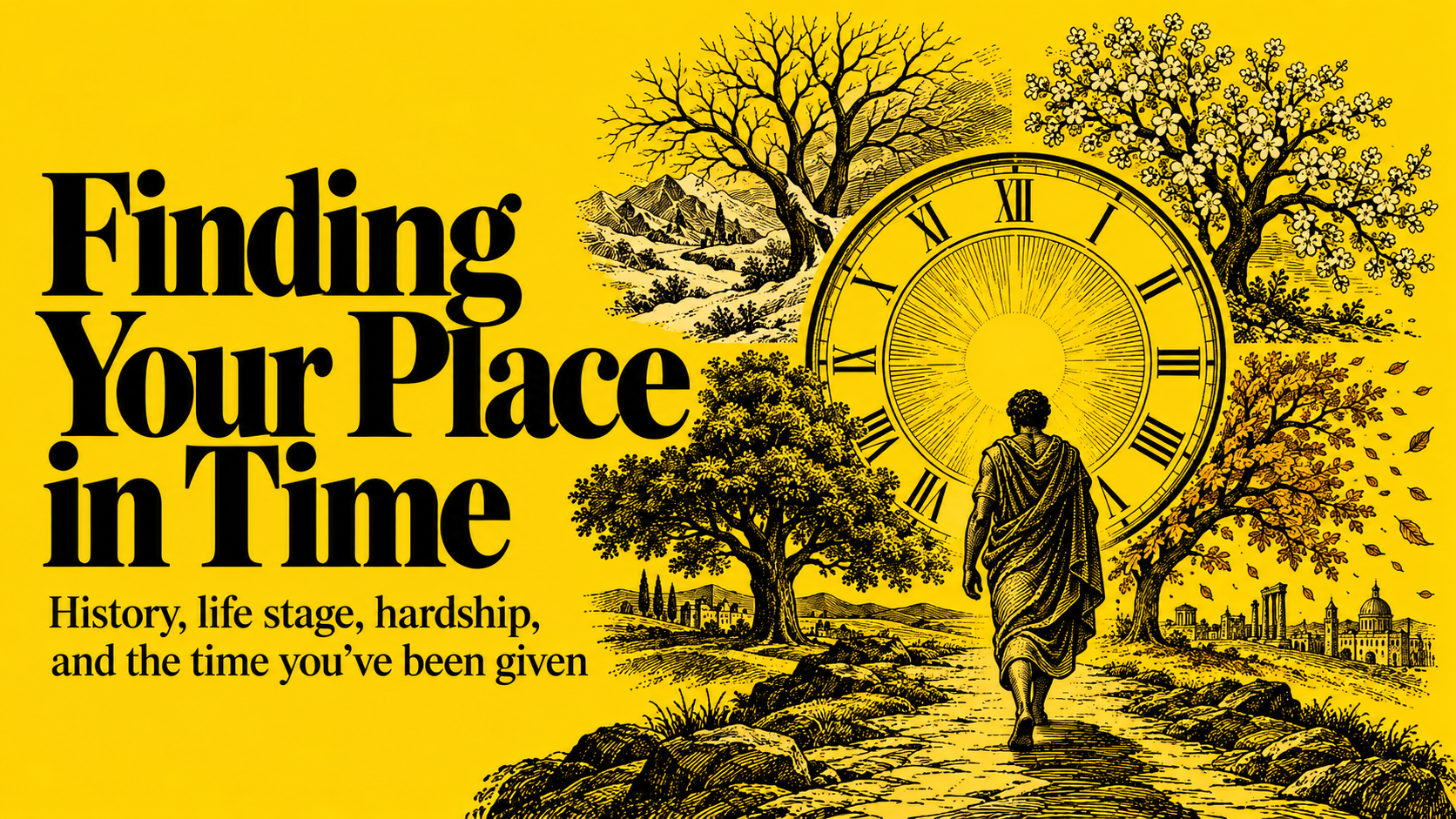
Ecclesiastes begins with generations coming and going, and then gives one of the oldest and simplest images for living in time: “For everything there is a season.” There is a time to begin and a time to stop, a time to gather and a time to let go, a time to mourn and a time to dance.
The seasonal image suggests patterns without pretending that history or individual lives move on a predictable schedule. It gives us language for beginnings, growth, harvest, decline, waiting, and renewal without turning the pattern into a law.
Beginning
Gift: possibility, experimentation, renewal.
Risk: naïveté, instability, impatience.
Building
Gift: strength, expansion, productivity.
Risk: excess, hubris, exhaustion.
Harvest
Gift: maturity, gratitude, discernment.
Risk: complacency, hoarding, nostalgia.
Reckoning
Gift: endurance, simplification, humility.
Risk: bitterness, rigidity, despair.
The temptation to turn a pattern into a law
You have probably heard the modern formula: hard times make strong people, strong people make good times, good times make weak people, and weak people make hard times. There is something worth noticing in it, but it is not a law of history.
Hardship can cultivate courage, endurance, competence, and solidarity. It can also traumatize, impoverish, brutalize, or kill. Peace and prosperity can let some survival capacities weaken, but they can also make room for education, art, medicine, generosity, and moral reflection.
A more modest claim is:
Every age trains certain muscles and allows others to weaken.
Ask two questions of your own time: What did this environment teach me well? And what did it make possible for me never to learn?
Ecclesiastes also protects us from romanticizing the past: “Do not say, ‘Why were the former days better than these?’” And in the same chapter it asks us to consider both prosperity and adversity. Historical perspective should make you less vulnerable to nostalgia, panic, and the assumption that the present condition will last forever.
A good strategy can become a bad strategy when the season changes
History has a clock. So does a human life.
Erik Erikson’s stages are most useful here as a set of changing questions, not a timetable you have to obey. The question that organizes one part of adulthood may stop being the question that matters most in the next.
Different seasons, different questions
- Adolescence and emerging adulthood: Who am I? What do I believe? What kind of person will I become?
- Early adulthood: Can I commit? Can I build a life with other people without losing myself?
- Middle adulthood: What am I building that matters beyond my own advancement? Who or what am I responsible for cultivating?
- Later adulthood: Can I receive my actual life as a whole, including what I cannot redo? What do I need to hand forward and relinquish?
A problem may persist because you are trying to solve the task of one season with the strategy of another.
Achievement can solve many early-adult problems. It cannot solve every midlife problem. Freedom may be necessary while identity is forming. Endless freedom can later prevent commitment. Control may help establish a life. Eventually control meets losses, bodies, other people, and historical changes that cannot be managed by greater effort.
The space between seasons
Sometimes the hardest period is not a season itself but the transition between them. The old role no longer works, and the new one is not yet clear. A career succeeds but stops satisfying. A child arrives. A child leaves. A parent dies. A marriage changes. The body changes. A long-held ambition is completed or abandoned.
It is possible to interpret that disorientation as proof that something has gone wrong.
Sometimes confusion means the old map no longer describes the territory.
A crisis can still be a crisis. But before you decide it proves something is wrong with you, it is worth asking whether life itself has changed the question.
Your story began before you arrived
You inherited more than a historical era. You inherited people, stories, expectations, loyalties, silences, habits, and unfinished problems.
Family
How did people handle anger, affection, money, work, weakness, conflict, responsibility, dependence, and success?
Culture & community
What did your region, religion, class, school, profession, or community teach you a respectable life should look like?
Generation
What did people your age learn to expect from adulthood, relationships, technology, institutions, work, and the future?
Most inheritances are mixed.
A family that prized self-reliance may have given you competence and made dependence difficult. A religious community may have given you belonging and moral seriousness while leaving little room for doubt or anger. A generation trained to adapt quickly to technology may also struggle to be unavailable, bored, or alone.
Your story began before you arrived, but you are not required to repeat every chapter you inherited.
Context is not excuse
Family and historical context can explain why a pattern made sense, or why it was hard to avoid. The consequences can still be yours to deal with now.
“My family never talked about emotion” may be true. “Men in my world were not taught this skill” may be true too. Knowing that helps. Eventually, though, another question arrives: What will you do with what you inherited?
Context does not remove responsibility. It makes responsibility more intelligent.
Hardship does not all mean the same thing
Modern life gives us many good reasons to reduce unnecessary suffering. But it can also encourage the assumption that discomfort itself proves something has gone wrong.
Not everything that hurts is pathology.
Sometimes pain is a warning. A boundary is being violated. A medical problem needs attention. A relationship is destructive. A decision has consequences. A habit is costing too much.
Scripture also presents another possibility: difficulty can form a person.
- James 1: trials test faith and produce perseverance.
- Romans 5: suffering can produce endurance, character, and hope.
- Hebrews 12: hardship is compared to discipline or training—painful in the moment, potentially formative later.
- Philippians 4: Paul says contentment is something he learned in changing circumstances.
None of these passages asks you to enjoy suffering. They do push against the assumption that the only good response to difficulty is to make it disappear as quickly as possible.
Some suffering should be changed
- abuse or exploitation
- avoidable danger
- destructive habits
- treatable problems
- injustice where action is possible
Some suffering must be carried
- mortality and aging
- certain losses
- irreversible choices
- other people’s freedom
- uncertainty and meaningful effort
And sometimes you will not know immediately which kind you are facing.
Some things should be changed. Some things must be carried. Wisdom includes learning the difference.
And grief belongs here. Some things have to be grieved before they can be carried. A loss does not need to become a lesson before it has been allowed to remain a loss.
A failed relationship may eventually teach you something. It is still a failed relationship. Years may produce wisdom. They are still years you cannot relive. Acceptance is not calling the loss good. It is allowing reality to be real.
“What can this teach me?” can be a useful question. It becomes harmful when used to skip “What happened?” “What was lost?” “What needs protection or repair?” and “What am I allowed to grieve?”
Neither helplessness nor omnipotence is clarity
Psychologist Julian Rotter used locus of control to describe differences in how people expect outcomes to depend on their own behavior versus forces outside them. In plain language: where do you tend to place the cause and control of what happens to you?
People sometimes talk as though an internal locus is healthy and an external one is not. That is too simple. Either extreme can put you out of touch with what is actually happening.
“This is all happening to me.”
Other people, systems, luck, history, and circumstances explain everything. The danger is passivity: action starts to seem pointless.
“What actually belongs to me here?”
Context matters. Other people matter. Chance matters. Your choices also matter. Responsibility is placed where the evidence says it belongs.
“Everything is up to me.”
Every outcome becomes proof of effort, mindset, discipline, or failure. The danger is imagined control and excessive self-blame.
Taking responsibility for everything is not the same as seeing reality clearly. Excessive self-blame can contain a hidden grandiosity: If everything was my fault, then maybe everything could have been prevented if I had only been better, wiser, stronger, or more careful. Sometimes that is easier to bear than admitting how much was never ours to control.
Clarity means locating responsibility where it actually belongs.
Change
I can act directly.
My behavior, commitments, requests, boundaries, preparation, repair, and next step.
Influence & respond
I cannot control the outcome.
I can communicate, adapt, participate, prepare, negotiate, vote, ask, help, or choose my response.
Accept, grieve, endure
I do not have meaningful control.
Mortality, the past, another person’s will, some losses, some conditions of the era I inhabit.
The time that is given us
In The Fellowship of the Ring, Frodo wishes the crisis confronting him had not happened in his time. Gandalf does not shame the wish. He agrees that anyone living through such a time would rather it were otherwise, then turns to the part that remains open to choice.
“All we have to decide is what to do with the time that is given us.”
J. R. R. Tolkien, The Fellowship of the Ring
Frodo does not choose his historical moment or the fact that the burden has arrived near him. His freedom exists inside conditions he did not choose.
That is closer to the kind of agency most of us actually have.
Amor fati and the obstacle
Nietzsche used the phrase amor fati—love of fate—for a radical willingness to affirm the actual life rather than continually wishing it had been another one:
“Amor fati: let that be my love henceforth!”
Friedrich Nietzsche, The Gay Science, §276
That does not require calling evil good. A useful psychological question remains: Can you stop withholding your life from the life that actually exists?
Marcus Aurelius makes a related Stoic move:
“The impediment to action advances action. What stands in the way becomes the way.”
Marcus Aurelius, Meditations 5.20 (wording varies by translation)
The obstacle itself is not magically good. It is simply there. Responding to it becomes part of the work.
Own what is yours. Recognize what is not. Respond faithfully to both.
Reality is stronger than your theory
Jung’s point was severe and practical: the picture you carry of the world eventually meets the world itself. If the picture is false, reality wins.
“We are overcome by the superior power of reality.”
C. G. Jung, “Analytical Psychology and Weltanschauung,” CW 8, ¶699
You may believe that good relationships should remain easy, hard work guarantees success, competent people can prevent most failure, adulthood should eventually feel settled, or progress should remove old human problems. Reality eventually tests the map.
A bad map creates unnecessary suffering because you fight not only the actual difficulty but also the conviction that this difficulty should not exist.
History should make you humbler, not more certain
Historical awareness can become its own arrogance. It is easy to decide that you know exactly which “season” society is in, what your generation means, or how future historians will describe the present.
Usually we understand an era more clearly after it has passed. The posture we want is pattern recognition without certainty: notice the patterns without pretending you can already see the whole picture.
There is a kind of chronological narcissism in both directions. We can imagine that our generation has finally outgrown the old human problems, or that no generation has ever faced anything as bewildering as ours. History is useful medicine for both.
History should implicate you, too
It is easy to study a destructive period and imagine that you would have been one of the clear-eyed people who resisted it. Jung warned against that confidence. Collective fear, resentment, tribal loyalty, ambition, obedience, and self-deception work through ordinary people, not a separate species of villain.
A more useful historical question is uncomfortable: Under what conditions might I become afraid enough, angry enough, certain enough, ambitious enough, or eager enough to belong that I would participate in something I now condemn?
History is not only a record of what other people were capable of. It is evidence about what human beings are capable of. That includes us.
Human nature changes less than we think. Human circumstances change more than we realize.
Receive the life that is here
Ecclesiastes does not answer impermanence by withdrawing from life. Again and again it returns to ordinary goods: food, drink, work, companionship, and the portion of life actually given to you. The seasons pass; that is part of why they should be received while they are here.
Knowing that something will end does not make it meaningless. Sometimes it is what makes attention possible.
Number your days
Eventually history presses the question closer to home: your own time is limited. You entered a story already underway, and you will leave before it is finished. That does not make life smaller. It makes postponement more expensive.
Psalm 90 asks God to “teach us to number our days, that we may gain a heart of wisdom.” This is less morbid than clarifying. A life has edges.
A limited life requires choices. Every real commitment closes alternatives. Every season ends. The question “What matters?” becomes more serious when time is no longer imagined as unlimited.
Know where you are. Know what time it is. Know what is yours to do.
“Why am I like this?” can only take you so far.
What does this time ask of you?
Your stage of life may be asking something. So may your family, your body, your work, a loss you did not choose, or an opportunity you did not expect.
You do not need a complete theory of your life to answer the smaller question:
What is mine to do now?
Put your problem back into time
Choose one problem that matters enough to study but is not so overwhelming that you cannot get any distance from it. You are not trying to explain it away. You are trying to see more of what is actually there.
Seven days of practice
- Day 1: Catch one moment when you ask, “What is wrong with me?” Add: “What kind of problem is this?”
- Day 2: Notice one assumption that feels like simple reality. Ask where and when you learned it.
- Day 3: Name one strength your generation or historical moment trained well—and one capacity it may have let you neglect.
- Day 4: Ask what task belongs to your current stage of life rather than the stage you wish you were still in.
- Day 5: Identify one inherited rule. Decide whether you want to keep it, revise it, or stop obeying it.
- Day 6: Put one difficulty into the three zones: change, influence/respond, accept/grieve/endure.
- Day 7: Complete the worksheet and answer one question plainly: “What is mine to do now?”
When you want to go deeper
A problem can become more workable once you can see what belongs to your history, your stage of life, your relationships, your circumstances, and your own choices. Counseling can help you sort those pieces without turning everything into either personal failure or something completely outside your control.
Explore counseling with JoelSources and further learning
This module is an educational synthesis. Biblical wisdom literature, Jungian psychology, lifespan development, life-course research, locus-of-control theory, Stoic philosophy, Nietzsche, and Tolkien come from different traditions and are not presented here as one unified theory. The layered problem locator, seasonal teaching framework, diagrams, worksheet, and practical exercises are teaching adaptations by Joel Looney Counseling.
- Ecclesiastes 1, 3, 7, 9, 11–12 — recurring human patterns, seasons, the danger of nostalgia, prosperity and adversity, ordinary participation in life, aging, and mortality.
- Psalm 90:12; James 1:2–4; Romans 5:3–5; Hebrews 12:5–11; Philippians 4:11–13 — mortality, perseverance, character, discipline, and learned contentment.
- Johann Wolfgang von Goethe, West-Eastern Divan — the importance of historical perspective beyond one’s own moment. English wording varies by translation.
- C. G. Jung, “The Spiritual Problem of Modern Man,” CW 10 — the relationship between upheaval in the world and upheaval in consciousness.
- C. G. Jung, “Analytical Psychology and Weltanschauung,” CW 8, especially ¶699 and ¶737 — worldview, reality-testing, and the relationship between our picture of the world and our picture of ourselves.
- C. G. Jung, The Symbolic Life, CW 18, ¶1400 — the danger of assuming oneself immune to collective evil and the importance of recognizing one’s own susceptibility.
- Erik H. Erikson, Childhood and Society and later lifespan work — psychosocial tasks across development, including identity, intimacy, generativity, and integrity.
- Glen H. Elder Jr. and the life-course tradition — lives as embedded in historical time and place; timing, linked lives, and human agency within constraints.
- Julian B. Rotter (1966), “Generalized Expectancies for Internal versus External Control of Reinforcement” — the internal/external locus-of-control framework.
- J. R. R. Tolkien, The Fellowship of the Ring — the distinction between the time we are given and what we choose to do within it.
- Friedrich Nietzsche, The Gay Science §276 — amor fati, or love of fate.
- Marcus Aurelius, Meditations 5.20 — hindrance as material for the next action.
- G. Michael Hopf and later popular discussion of historical cycles — the modern “hard times / strong people” formulation is used here only as an intuition about changing capacities, not as a law of history.
Historical, generational, developmental, and family context can improve understanding, but none of these frameworks can tell you what a particular person “must” be like. They should not be used to dismiss abuse, coercion, injustice, medical conditions, trauma, disability, neurodevelopmental differences, or another person’s actual behavior. Education does not replace individualized care.
Biblical texts used for reflection: Ecclesiastes 1, 3, 7, 9, 11–12; Psalm 90:12; James 1:2–4; Romans 5:3–5; Hebrews 12:5–11; Philippians 4:11–13.
Faith framework: Biblical texts are included as part of Joel Looney Counseling’s Judeo-Christian framework and as resources for reflection. You do not need to share these beliefs to use the educational material.