
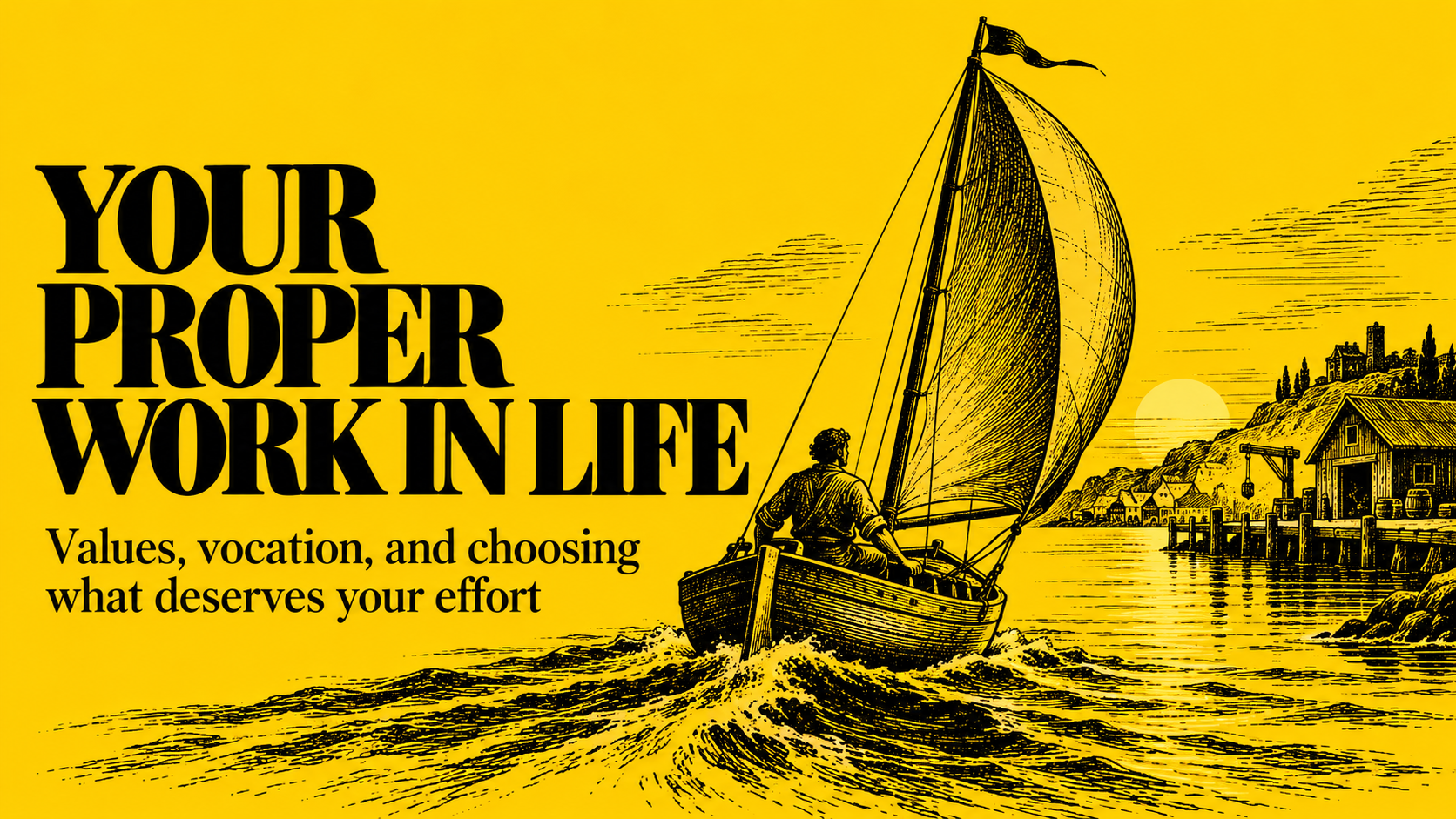
Your Proper Work in Life
Values, vocation, and choosing what deserves your effort.
You can care about many good things and still live without a clear center. Work, money, family, health, service, pleasure, faith, security, achievement, and approval can all matter. The harder question is what place each should occupy—and what deserves to organize the rest.
A life can have a governing purpose larger than any single role or season. The work is learning how that purpose takes form here: what deserves your effort, which opportunities serve it, what must receive less weight, and what faithfulness asks of you now.
BeginBefore you begin
- A life can have one governing purpose while containing many callings, roles, and seasons.
- Not every responsibility is chosen. Wisdom includes recognizing what has actually been entrusted to you.
- Many hard decisions are not good versus bad. They are good versus good.
- A priority becomes real when it begins to organize other choices.
You are already spending your life. The question is what you are spending it on.
A finite life cannot give everything equal weight. Clarity means deciding what deserves to shape your time, attention, loyalty, sacrifice, and care.
The world is already offering you an answer
In 1907 Rudyard Kipling addressed students at McGill University about what he called “Values in Life.” He warned them that they were entering a world ready to teach them that wealth was the governing idea of life. His advice was not to reject money or ambition. It was to keep them in their place.
“If more wealth be necessary to you…use your left hand to acquire it, but keep your right for your proper work in life.”
Rudyard Kipling, “Values in Life,” McGill University, 1907
The problem has not aged much. Every culture offers ready-made scorecards. Make enough money. Be admired. Stay desirable. Become indispensable. Keep your options open. Be productive. Look like someone who has figured it out.
Money can provide, beauty can delight, competence can serve, reputation can open doors, and achievement can express real ability. Trouble begins when one of these good things quietly becomes the answer to a larger question:
What is my life for?
If you do not answer that question deliberately, something else will answer it for you.
Your schedule answers. Your anxieties answer. The people you envy answer. The opportunities you cannot refuse answer. The things you protect at any cost answer.
The deeper problem is that borrowed ambition eventually stops feeling borrowed. The life everyone knows how to applaud can begin to feel like the life you freely chose.
Freedom from tells you what no longer governs you. Freedom to asks what you are willing to love, build, serve, and give yourself to.
This is why values work is more demanding than listing admirable words. Most people value family, honesty, health, meaningful work, friendship, and growth. The real test comes when two good things make competing claims on the same Tuesday afternoon.
Not everything you care about does the same job
Values, priorities, goals, and commitments are related, but they are not interchangeable.
Value
A quality or direction of living: honesty, generosity, courage, faithfulness, learning, care.
Priority
A good that receives greater weight now because of this season, responsibility, or decision.
Goal
An outcome you can reach: finish a degree, save an amount, have a conversation, complete a project.
Commitment
An arrangement that gives a value or priority a place in behavior: time, money, boundaries, habits, promises.
In Acceptance and Commitment Therapy, a value is more like a direction than a destination. You can finish a marathon; you cannot finish being courageous. You can complete a date night; you cannot complete loving your spouse.
You may value your marriage, your children, meaningful work, friendship, health, service, creativity, and rest. All of them can be genuine. They still cannot all receive maximum attention at once.
That is where priority enters. A priority answers a more uncomfortable question:
What deserves greater weight in this season?
Commitment asks whether that answer will remain an idea or begin changing how life is arranged.
Value: I want to be a present father. Priority: My daughter needs more of my attention during this transition. Goal: Be home for dinner four nights this week. Commitment: No appointments after 5:00 on those nights, and my phone stays away during dinner and bedtime.
A goal without a value can become an empty achievement. A value without a commitment can remain a flattering description of who you imagine yourself to be.
You may not have the whole map. You still need a harbor.
Direction changes the meaning of opportunity.
A promotion, move, invitation, new client, degree, relationship, investment, ministry role, or open door can all be genuinely good. A good opportunity can still be the wrong opportunity for you. Its value depends partly on where you are going.
“When a man does not know what harbour he is making for, no wind is the right wind.”
SENECA · MORAL LETTER 71Seneca’s larger point is about aim. The painter must know what he is trying to paint. The archer must know what he is trying to hit.
You need enough direction to distinguish a favorable wind from a distracting one.
Without direction, every strong wind starts to look favorable. More money? Take it. More visibility? Take it. More responsibility? Prove you can carry it. A chance to avoid disappointing somebody? Say yes.
Direction introduces another question:
Does this opportunity help me become more faithful to what I have decided matters—or merely give me another way to succeed?
Direction does not require mastery of the road ahead. It requires enough orientation to move faithfully when the whole route is not visible.
What if you succeed?
One of the dangerous possibilities in life is not failing. It is succeeding at something that costs more than it is worth.
A Pyrrhic victory is a win purchased at such a destructive cost that the victory begins to resemble defeat.
Can an entire life become a Pyrrhic victory?
You get the promotion and lose the marriage. You build the business and become a stranger to your children. You preserve everybody’s approval and lose the ability to say what you actually think. You become indispensable at work and unavailable everywhere else.
The problem is not success. It is a success that destroys what the success was supposed to serve.
Lose the relationship’s capacity for honesty and repair.
Lose the freedom to disappoint people when conscience requires it.
Lose decades to the pursuit of a safety that never finally arrives.
Lose contact with the ordinary person underneath it.
Aleksandr Solzhenitsyn made a related argument in his 1978 Harvard address. Material progress can coexist with spiritual loss; a civilization can gain more and become less capable of naming what the gain is for.
“We were being deprived of our most precious possession: our spiritual life.”
Aleksandr Solzhenitsyn, “A World Split Apart,” Harvard University, 1978
Success does not tell you, by itself, whether the thing succeeded at was worthy—or what the success cost.
Jesus asks the same question with considerably higher stakes:
“For what shall it profit a man, if he shall gain the whole world, and lose his own soul?”
Mark 8:36, KJV
Jesus is speaking about more than psychological wholeness. Yet his warning reaches immediately into ordinary life: Can you obtain what you wanted and damage the self that was supposed to love, choose, receive, and live with what you gained?
A Pyrrhic victory wins at a cost greater than the victory. Jesus asks whether an entire life can become one.
TOWARD
What are you trying to build?
Imagine several years of giving greater weight to what is genuinely worth caring about. What relationships, character, work, contribution, and way of living might become more possible?
AWAY
What are you unwilling to become?
Imagine several years of your current distortions going largely unchecked. What kind of life could you plausibly drift into?
Look both ways: toward the life worth building and toward the life you refuse to drift into. Direction becomes clearer when you can see both what you are trying to build and what you are unwilling to become.
Something will come first—and order the rest
The warning in Mark 8 leaves a positive question: if gaining everything can still become loss, what deserves first place?
In Matthew 6 Jesus speaks about money, provision, clothing, tomorrow, worry, and divided loyalties—ordinary concerns that can become organizing powers. Then he says:
“But seek ye first the kingdom of God, and his righteousness; and all these things shall be added unto you.”
Matthew 6:33, KJV
The Kingdom is more than a personal value. It is the reign of God: life reordered around the reality, goodness, and will of God. “Seek first” names an allegiance. It places God’s reign above the goods that clamor to organize a life.
The psychological truth follows from the spiritual one: something becomes first, and whatever becomes first begins to tell the other goods what place they may occupy.
First does not mean only.
Money, work, family, pleasure, achievement, security, and recognition can all be real goods. The danger is asking any of them to become ultimate.
Augustine gives us another way to say this. In the Confessions he writes, “My weight is my love.” Love pulls and directs us. Christian tradition develops this into the idea of an order of love: maturity does not require treating ordinary goods as evil. It requires giving them a fitting place.
Ordinary goods belong in a good life. They become destructive when asked to carry more than they can bear.
Your strongest desire deserves attention. It does not deserve authority merely because it is strong.
Vocation is larger than a job and smaller than saving the world
Vocation is larger than career. It is the way first things take form in actual responsibilities, relationships, gifts, and work.
Your proper work is the part of the good that is actually yours to carry: the responsibilities, relationships, crafts, services, and tasks entrusted to you and worthy of faithful effort. Some may be paid. Much will not be.
How do you discern what is actually yours to carry? Four questions help.
01 / WORTH
Is it genuinely good?
Does this serve a real good rather than merely offering approval, relief, status, or the feeling of being needed?
02 / RESPONSIBILITY
Is it actually mine?
Does this belong to my role, promise, relationship, or legitimate responsibility—or am I taking over what belongs to someone else?
03 / CAPACITY
Can I meaningfully contribute?
Do I have, or can I reasonably develop, the ability, position, support, and resources needed to take this on faithfully?
04 / SEASON
Is it mine now?
A good calling can arrive at the wrong time. What deserves weight in this season may differ from what deserves weight later.
It is larger than a job
A career can be part of a vocation, but so can:
- raising children
- caring for a parent
- making a marriage more honest
- building a craft
- serving a community
- becoming trustworthy with what has been entrusted to you
It is smaller than saving the world
You can be called to responsibility without being called to sovereignty. Proper work has edges. Other people remain free. Outcomes remain uncertain. Limits remain real.
A calling can ask much of you without making you responsible for everything.
Genesis 12 gives a fitting image. Abram receives a direction before he receives a map. He is asked to leave, go, and become a blessing, but he is not given control over how the entire promise will unfold.
That is often how vocation works: enough light for obedience, not enough for control.
Vocation does not have to be exceptional to be real. A person may spend years doing work that never becomes a platform, brand, movement, or story strangers want to hear. Faithfulness is not measured by audience size.
Take your life seriously without making yourself the center of it.
Proper work eventually draws attention beyond the self—toward another person’s need, another person’s joy, a craft worth practicing, a promise worth keeping, or a good worth serving.
The mature question becomes not only What kind of life do I want? but:
What do I want my life to serve?
Every real yes creates a no somewhere else
A finite life cannot remain infinitely open.
Choosing a spouse means relinquishing other romantic possibilities. Raising children changes the use of time and money. Serious work competes with leisure. Service can limit advancement. Health may require saying no to convenience. A season of caregiving can interrupt plans that were genuinely good.
That is what weight looks like.
This deserves more
Time, attention, money, preparation, presence, protection, or courage.
So something receives less
Availability, comfort, optional opportunity, speed, income, recognition, spontaneity, or another legitimate good.
“Balance” can be a poor ideal. Equal distribution is not always wise distribution. A new baby, a dying parent, a demanding training season, a threatened marriage, an illness, or a rare opportunity can rightly make life temporarily lopsided.
The better question is whether you can give an honest account of the disproportion: Does it fit the season? Does it serve a good you actually endorse? Is it costing more than that good can justify?
Choosing one life means not living several others. A good decision can still contain grief.
Values without tradeoffs remain preferences.
Psalm 90 asks for wisdom in light of numbered days. Mortality does not tell you exactly what to choose. It removes the illusion that every possibility can be kept indefinitely.
A priority eventually becomes visible
Over time, what receives real weight leaves evidence.
INTERACTIVE / WHERE DOES A PRIORITY BECOME VISIBLE?
The Weight Test
Select a category. The purpose is not to score yourself. It is to look for the practical form your stated priority would take.
Time
Where would this priority need protected time rather than whatever is left over? Constraints may limit your freedom, but a priority often requires some deliberate claim on the calendar.
The calendar is not a perfect moral document, but it is one place where our loves acquire weight.
So are spending, preparation, boundaries, and repeated choices. If you say friendship matters but never initiate, the value has not yet become a commitment.
This is where confidence becomes more than self-assurance. Confidence here means being willing to choose a direction, organize around it, and accept responsibility for the choice.
Value → Priority → Commitment → Cost
Your values should eventually make room for other people to flourish
The self can become an endless project. Every relationship becomes a mirror, every habit a metric, every season another chance to optimize the person in the center.
Direction also becomes stewardship: caring for what has been entrusted to you and helping create conditions in which other people can grow.
The question What kind of life do I want? therefore has to deepen into What do I want my life to serve?
Sometimes your proper work is ambitious. Sometimes it is hidden. Sometimes it is a season of building. Sometimes it is repair. Sometimes it is learning to receive rather than achieve. Sometimes it is doing less of what you are good at because someone you love needs you elsewhere.
You do not need to prove that your life is important. You do need to decide what is worth giving it to.
Priorities should be reviewed. Seasons change. New information arrives. Commitments sometimes need to be relinquished. But revision is different from drift.
You are allowed to change your mind. You should still have one.
Translate one value into a priority
Do not try to redesign your whole life. Choose one area where greater clarity would matter now. The aim is to move from an admired value to a concrete, proportionate commitment.
Let one priority acquire weight
- Day 1: Notice one ready-made scorecard. Ask, “Who taught me that winning here would mean I am doing well?”
- Day 2: Name your harbor. Write one sentence describing the direction you want this season of life to serve.
- Day 3: Test one strong wind. Ask whether a current opportunity actually moves you toward that direction or merely offers another way to succeed.
- Day 4: Ask the Pyrrhic question: “If I won here, what could the victory cost me?”
- Day 5: Name one good thing that has become too heavy—something important that is beginning to act as if it were ultimate.
- Day 6: Say one necessary no that protects a more important yes, or do one piece of “proper work” that benefits someone else without improving your image.
- Day 7: Complete the worksheet. Keep one commitment for the coming week and decide when you will review it.
When you want to go deeper
It can be difficult to sort genuine values from inherited expectations, approval-seeking, fear, over-responsibility, or a life organized around avoiding regret. Counseling can help you clarify what matters, recognize the patterns competing for authority, and translate direction into choices that fit your actual life.
Explore counseling with JoelSources and further learning
This module is an educational synthesis. Acceptance and Commitment Therapy, Self-Determination Theory, philosophical accounts of meaning and value, Christian theology, biblical texts, and literary reflection come from different traditions and are not presented as one unified empirical theory. The Good–Place–Weight framework, harbor application, Pyrrhic-victory application, Weight Test, worksheet, and practical exercises are teaching adaptations by Joel Looney Counseling.
- Rudyard Kipling, “Values in Life” (1907) — wealth, “smartness,” proper work, and the danger of allowing a socially rewarded good to govern the whole life.
- Seneca, Moral Letter 71 — direction, aim, and the “harbor” that makes it possible to judge whether a wind is favorable.
- Erich Fromm, Escape from Freedom — background for the distinction between borrowed social aims and positive freedom expressed through spontaneous love and creative work.
- Aleksandr Solzhenitsyn, “A World Split Apart” (Harvard, 1978) — material progress, spiritual loss, and the inadequacy of material expansion as a measure of human flourishing.
- Jordan B. Peterson / Future Authoring — background for the “two possible futures” reflection: imagining both a future worth building and a plausible future one does not want to drift into. It is used here as a limited exercise, not as a comprehensive theory of motivation.
- Augustine, Confessions XIII.9 and City of God XV.22 — love as weight and the ordering of love. English wording varies by translation.
- Mark 8:36; Matthew 6:19–34; Psalm 90:12; Genesis 12:1–4; Ecclesiastes; Philippians 3:7–14 — gaining the world and losing the soul, seeking first the Kingdom, treasure and service, finitude, calling without a full map, receiving a finite life, and re-evaluating former gains.
- Steven C. Hayes, Kirk Strosahl & Kelly Wilson, Acceptance and Commitment Therapy — values as chosen directions and committed action. Values measurement within ACT remains an active area of research rather than a single settled construct.
- Richard M. Ryan & Edward L. Deci, Self-Determination Theory — intrinsic and extrinsic motivation, basic psychological needs, and the quality of motivation.
- Kennon Sheldon, Richard Ryan, Edward Deci & Tim Kasser (2004), “The Independent Effects of Goal Contents and Motives on Well-Being” — evidence that both what people pursue and why they pursue it matter.
- E. L. Bradshaw and colleagues (2023), Journal of Personality and Social Psychology — meta-analytic work on prioritizing extrinsic versus intrinsic aspirations and well-being.
- Susan Wolf, Meaning in Life and Why It Matters — meaning as involving both subjective attraction and engagement with something genuinely worth caring about.
- Søren Kierkegaard, Either/Or and Concluding Unscientific Postscript — choice, appropriation, and the movement from possibility into a lived commitment.
- Harry Frankfurt, The Importance of What We Care About — care, identification, and the difference between having a desire and allowing it to govern.
- Viktor Frankl; Carol Ryff; Laura King & Joshua Hicks; Dan McAdams — meaning, purpose, well-being, generativity, and narrative identity.
Research on intrinsic and extrinsic aspirations concerns patterns of priority and motivation; it does not make money, achievement, appearance, or recognition inherently bad. Real choices are also shaped by caregiving, illness, economic limits, disability, coercion, and other constraints.
Biblical texts used for reflection: Mark 8:36; Matthew 6:19–34; Psalm 90:12; Genesis 12:1–4; Ecclesiastes; Philippians 3:7–14.